Michele Lomaglio
Supervisor
Emilio Macchia
Michele Lomaglio
Supervisor
Emilio Macchia
Dissent by Design
Research Question
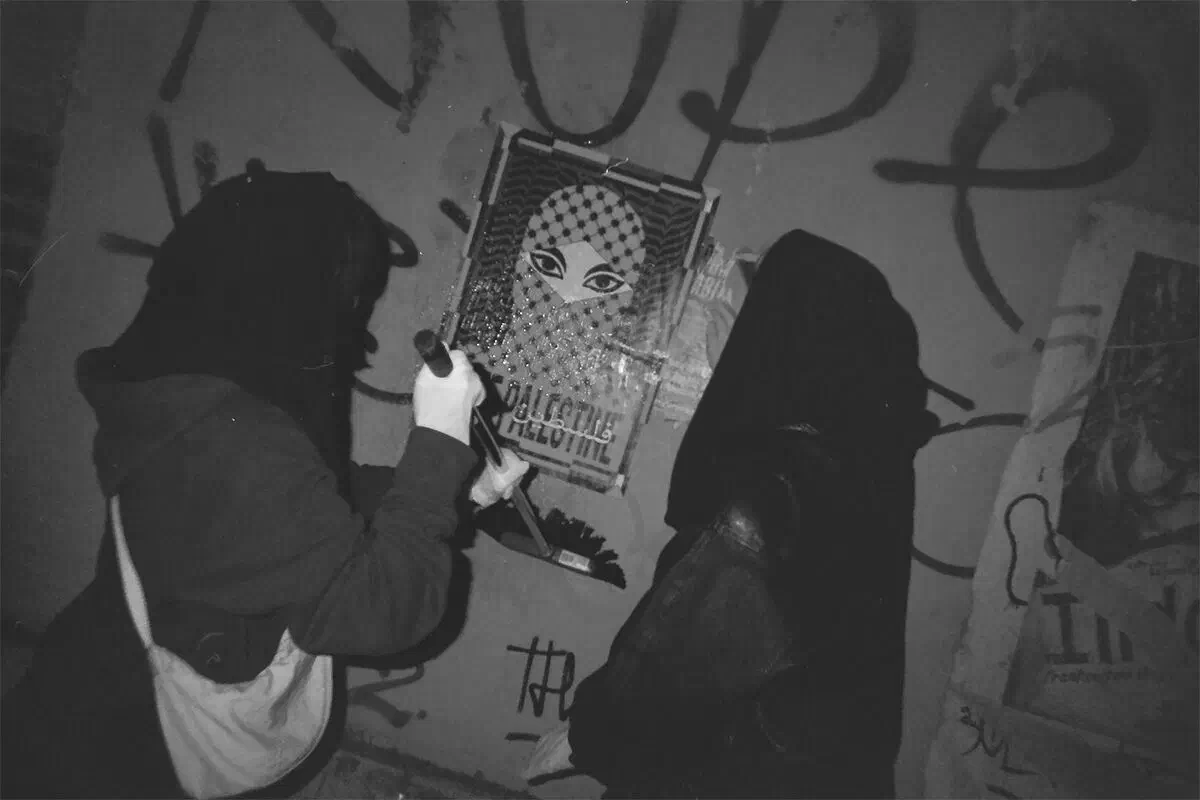
The research will analyse posters produced and circulated between 2020 and 2025 as intentional tools of political struggle — in contexts of armed conflict, occupation, political dissent, and civil and environmental rights movements. The corpus will be delimited according to three criteria: temporal (2020–2025), geographical (contexts with markedly different censorship regimes and graphic traditions), and typological (analogue and digital posters designed by autonomous collectives or independent graphic designers — including anonymous or clandestine material — and treated as a methodological variable rather than an obstacle). For each case study, the research will reconstruct the local history of the poster as a form of dissent, with the aim of understanding its iconographic roots, socio-political contexts, and structural constraints — such as censorship, self-censorship, and scarcity of resources — and their impact on production and dissemination.
Research Methodology
The research is structured into three phases. In the first phase (data collection), semi-structured interviews will be conducted with designers selected according to explicit criteria: direct experience in working in contexts of conflict or repression, and belonging to either autonomous collectives or independent practice. Visual material will be drawn from documented archives, as well as from primary sources in the field or abroad, including anonymous or clandestine material. In the second phase (analysis), the collected material will be examined through semiotic and iconographic frameworks to identify recurring visual patterns and communicative strategies. In the third phase (cross-case comparison), the findings from the individual case studies will be brought into dialogue in order to identify shared and distinctive characteristics across different practices of graphic resistance.
Case Studies
The present research will analyse examples of graphic resistance drawn from diverse cultural and political contexts, selected for the variety of their censorship regimes and local graphic traditions. The initial case study will focus on Iran, a country selected due to the complexity of its state censorship apparatus and the depth of its graphic resistance tradition. The second case study will focus on the United States, a context in which protest graphics operate within a regime of formal freedom but amidst dynamics of commercial co-optation and political polarisation. The third case study — to be selected from East Asia, Sub-Saharan Africa or Latin America — will be chosen based on the availability of documented material and the accessibility of direct contacts.
Data Analysis and Interpretation
The final findings aim to provide a fluid and comparative analysis of the case studies, examined alongside the subjective and objective characteristics of the various forms of resistance. The material gathered will be used to identify lines of continuity and rupture across different contexts, both in terms of design traditions and in terms of the social and political conditions of production. The objective of this study is to establish a set of good practices for the creation and dissemination of resistance graphics, encompassing local particularities without forgoing a global comparative perspective.
Bibliography
Bibliography
D., Gade, S., Thylstrup, N. B., & Veel, K. (Eds.). (2021). (W) archives: Archival imaginaries, war, and contemporary art. Sternberg Press.
Lo, K. Y. K. (2024). Design against design: Cause and consequence of a dissident graphic practice. Set Margins’ publications.
Mareis, C., & Paim, N. (Eds.). (2021). Design struggles: Intersecting histories, pedagogies, and perspectives. Valiz.