Margherita Malerba
Supervisor
Ludovica Privitera
Margherita Malerba
Supervisor
Ludovica Privitera
God is Dead. The Order of Chaos / The New Social Utility: Graphic Design is on Stage
Graphic design is on stage
Research Question
In 2023, italian playhouses saw a more modest increase in audience numbers (+1.74%) compared to the rise in the number of performances (+5% compared to 2019); this reveal an imbalance between production and audience response (SIAE Report, 2023). Although graphic design and audience development are established fields, their intersection as a practice aimed at bringing audiences back to the theatre remains unexplored: for instance, 50% of Italian theatres do not have staff dedicated to visual communication, and 80% do not have a strategic plan to address this aspect (D. Agostino et al., 2022–2024). Using design as a practice for orienting oneself in the world (Willis, as cited in Haghighi et al., 2025), this research investigates the extent to which graphic design can act as a trigger for a return to the theatre.
Methodology for Achieving the Objectives
The research adopts a ‘Research through Design’ approach. After an initial mapping of the visual identities of Italian theatres and theatrical companies, the aim is to identify ‘recurring patterns’ that have effectively helped to increase audience attendance. The research will then measure, through the creation of experimental graphic artefacts, the variables of perception, engagement and emotional response, using surveys to analyse the theatre audience’s response to these visual prompts. The results will then be cross-referenced with attendance data provided by partner theatres, to investigate their impact. If the outcome of the interventions is positive, the artefacts will be tested based on the principles derived, to investigate whether they are transferable to other theatrical contexts; these will becodified into a visual pattern − derived from the recognition of recurring patterns − of transferable graphic design principles.
Case Studies
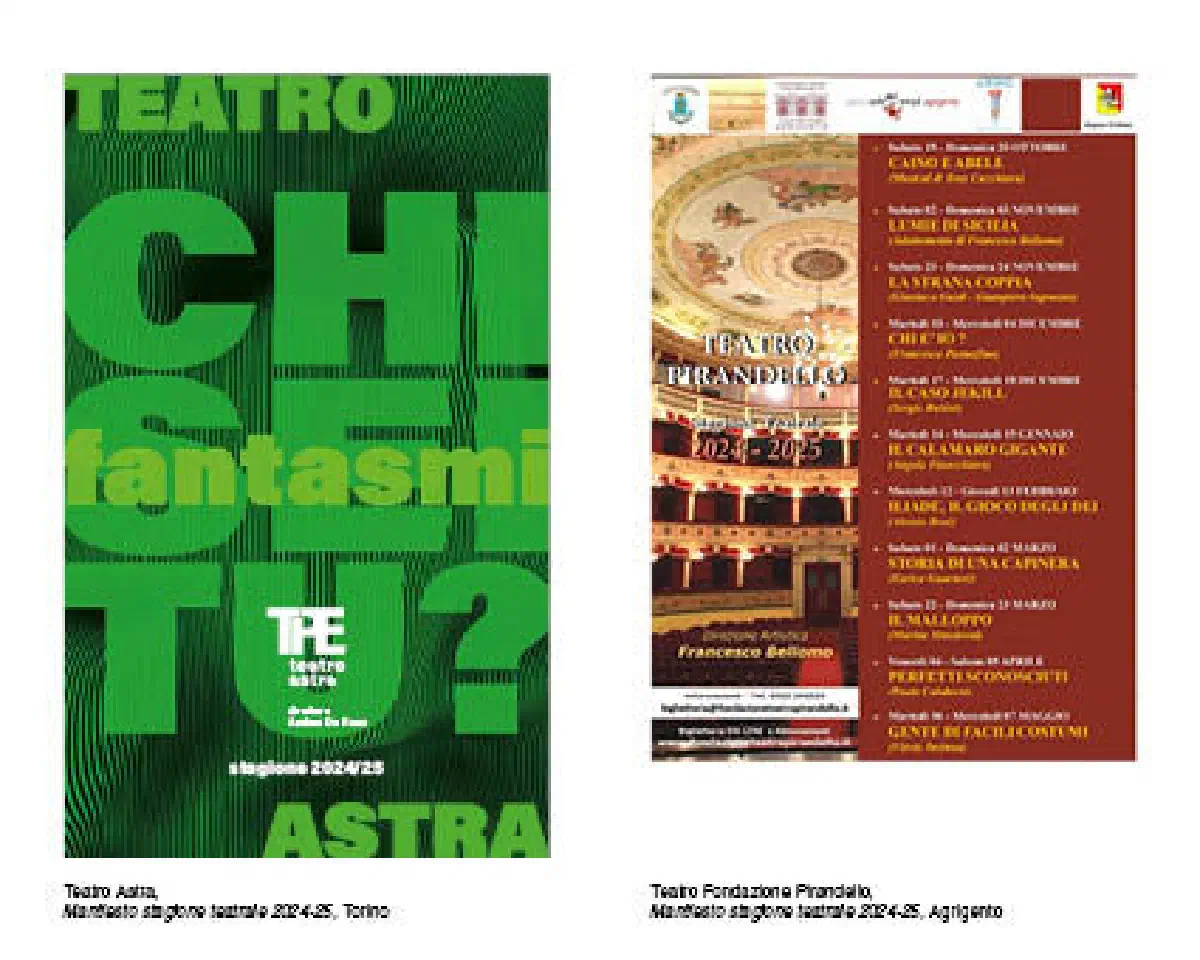
The mappings have revealed contrasting responses to graphic design strategies: the Teatro Astra in Turin, for example, over the three-year period 2022–25, with its new graphic design led by the communications agency Arkè (Naples), has seen a gradual increase in audience numbers; whereas the 2024–25 season of the Teatro Fondazione Pirandello for Agrigento as Capital of Culture, which was not entrusted to a professional graphic designer, did not generate much audience engagement.
Experimentation and analysis are currently underway at Kamerni Teatar 55 (BiH) and Malmö Stadsteater (SWE).
Data Analysis and Interpretation of Results
From the experimental data, it will be possible to identify recurring patterns in the cognitive and affective response to the artefacts produced; this will enable an initial validation of these artefacts, to be carried out using a sample of non-theatre-goers. Using the data obtained, a visual alphabet will be developed, with the aim of identifying a set of replicable principles that can be understood as best practices for public service graphic design; the intended visual alphabet is a flexible and adaptable framework, designed to guide the design choices of theatre institutions in various contexts.
Bibliography
Bibliography
Haghighi, N., Yu, S., Landay, J., & Rosner, D. (2025). Ontologies in design: How imagining a tree reveals possibilities and assumptions in large language models. In Proceedings of the 2025 CHI Conference on Human Factors in Computing Systems (CHI ‘25). ACM. https://doi.org/10.1145/3706598.3713633
Alnasser, N. S., & Yi, L. J. (2023). Strategies applied by different arts and cultural organizations for their audience development: A comparative review. Heliyon, 9(5), Article e15643. https://doi.org/10.1016/j.heliyon.2023.e15643
Lupton, E. (2020). Design is storytelling. Cooper Hewitt.
Poli, K. (2021). The field of cultural and creative production: A reading through Bourdieu’s theory of fields. Revista Extraprensa, 14(2), pp. 81–103. https://doi.org/10.11606/extraprensa2021.189478
Poynor, R. (2023). Why graphic culture matters: Essays, polemics and proposals about art, design and visual communication. Occasional Papers.