Marco Orazio Re
Supervisor
Lorenzo Di Silvestro
Marco Orazio Re
Supervisor
Lorenzo Di Silvestro
Digital Technologies for Cultural Mediation: A Framework for Meaning-Making in Museums
Uno strumento per il meaning-making nei musei
Research question
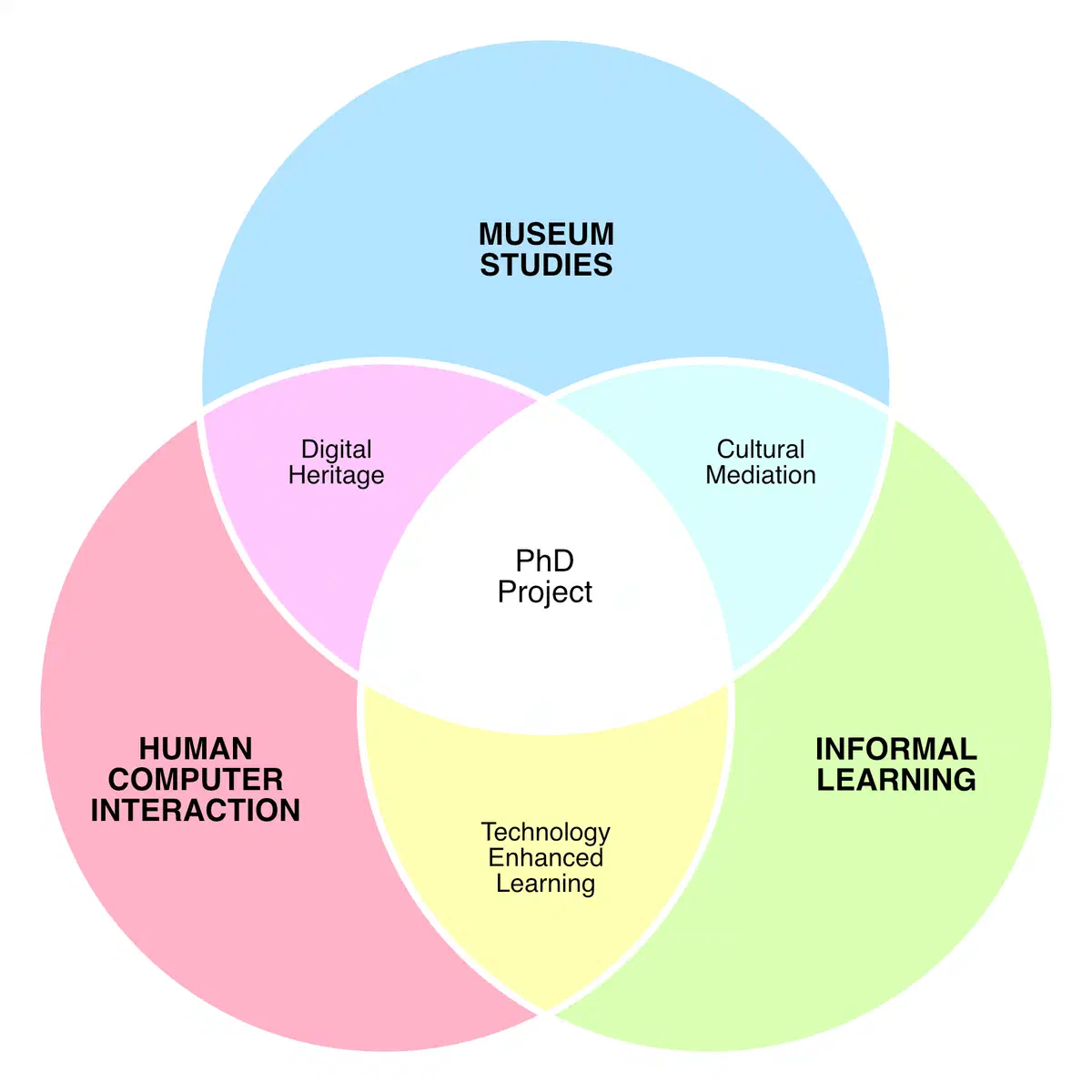
How can a framework for cultural mediation based on annotation and sharing foster meaning-making in museums? This research draws on the 2022 ICOM definition of a museum as a participatory institution that promotes reflection and knowledge sharing. The theoretical framework integrates five perspectives: the museum as a space for transformative experiences (Sabiescu et al., 2025), the factors that make the museum experience meaningful (Morse et al., 2023), the active construction of meaning by the visitor (Todino & Campitiello, 2025), informal learning as a free and socially mediated process (Pierroux et al., 2022), and best practices for non-invasive museum technologies (Hornecker & Ciolfi, 2019). On this basis, the research aims to develop both a tool for cultural mediation and an application prototype for its validation through case studies. This tool is based on two concepts: the first is annotation, which invites visitors to articulate their experience through an emotional register (what I felt) and an interpretive one (what it made me think). The second is the anonymous sharing of these annotations with other visitors.
Methodology for achieving objectives
The project follows a design-based methodology with a mixed-methods approach to data collection and is divided into the following phases:
Review of the literature and existing museum apps to define the framework Administration of questionnaires to museum directors and visitors to analyze the level of institutional digitalization and visitors’ propensity to use digital tools Design of the prototype (museum app) for the implementation of the framework Installation testing of the prototype at selected case study museums to observe its use in a real-world context Analysis of data collected from prototype usage, questionnaires, and visitor interviews to evaluate the experience and meaning-making processes Iterative validation of the methodology and prototype based on the analyses conducted
Case studies
The case studies will be selected from among Sicilian art museums based on the following criteria: The availability of guided tours in addition to self-guided tours, to compare the role of the tool and methodology with and without guided interpretation The absence of museum apps, to test the prototype and methodology, without interference from existing solutions
Data analysis and interpretation of results
The data collected in the second phase will be analyzed using descriptive analysis to guide the design of the prototype. For the case studies, post-visit questionnaires will provide quantitative data on the impact of the adopted framework. The interviews, analyzed using thematic analysis, will help us understand how visitors perceive the value of annotation and sharing. Finally, log data will provide behavioral indicators. The results, including any negative outcomes, will guide revisions to the adopted methodology and the prototype.
Bibliography
Bibliography
Morse, C., Niess, J., Bongard-Blanchy, K., Rivas, S., Lallemand, C., & Koenig, V. (2023). Impressions that last: Representing the meaningful museum experience. Behaviour & Information Technology, 42(8), pp. 1127–1154. https://doi.org/10.1080/0144929X.2022.2061375
Pierroux, P., Knutson, K., & Crowley, K. (2022). Informal learning in museums. In R. K. Sawyer (Ed.), The Cambridge handbook of the learning sciences (pp. 448–464). Cambridge University Press. https://doi.org/10.1017/9781108888295.02
Sabiescu, A., Calvi, L., & Vermeeren, A. (2025). Introduction: Transformative museum experiences at a time of transformation. In L. Calvi, A. Vermeeren, & A. Sabiescu (a cura di), Transformative museum experiences (pp. 1–23). Springer Nature Switzerland. https://doi.org/10.1007/978-3-031-89521-0_1
Todino, M. D., & Campitiello, L. (2025). Museum education. Encyclopedia, 5(1), 3. https://doi.org/10.3390/encyclopedia5010003