Lucia Lamacchia
Supervisor
Ciro Esposito
Lucia Lamacchia
Supervisor
Ciro Esposito
Another World is Visible: Constructing the Gaze and Politics of Imagination
Constructing the Gaze and Politics of Imagination
Research question
Which visual practices generate alternative representations to those of the scopic regime promoted by capitalism in the contemporary Western context?
Methodology
The research proposes an interdisciplinary theoretical-critical analysis that integrates communication design, art history, visual culture, philosophy and anthropology. It is situated within the framework of research through design, while also incorporating elements of research through arts and practice-led research. The methodological approach is based on field observations conducted by comparing visual representations across heterogeneous contexts, as well as qualitative investigations through semi-structured interviews.
Case studies
Many visual conventions are not normally documented in writing. The comparison between different socio-cultural dispositifs – in terms of the organization of visual space, body-image relations, rituals and symbols – allows an interrogation of the conditions of visibility within which collective experience is articulated. In this context, Disneyland Paris is selected as a model of perceptual structuring that is designed to promote consumption; Studio Orta (Les Moulins, France) as a critical design practice in relation to dominant Western models; and Hà Nội (Vietnam) as an alternative cultural setting characterized by a marked plurality of configurations of the visible. For a wider perspective, the research will extend to Izmir (Turkey), a scenario of historical, cultural and urban stratifications; and to the La Spezia prison (Casa circondariale della Spezia), an institutional environment strongly regulated by scopic regimes.
Data analysis and interpretation of results
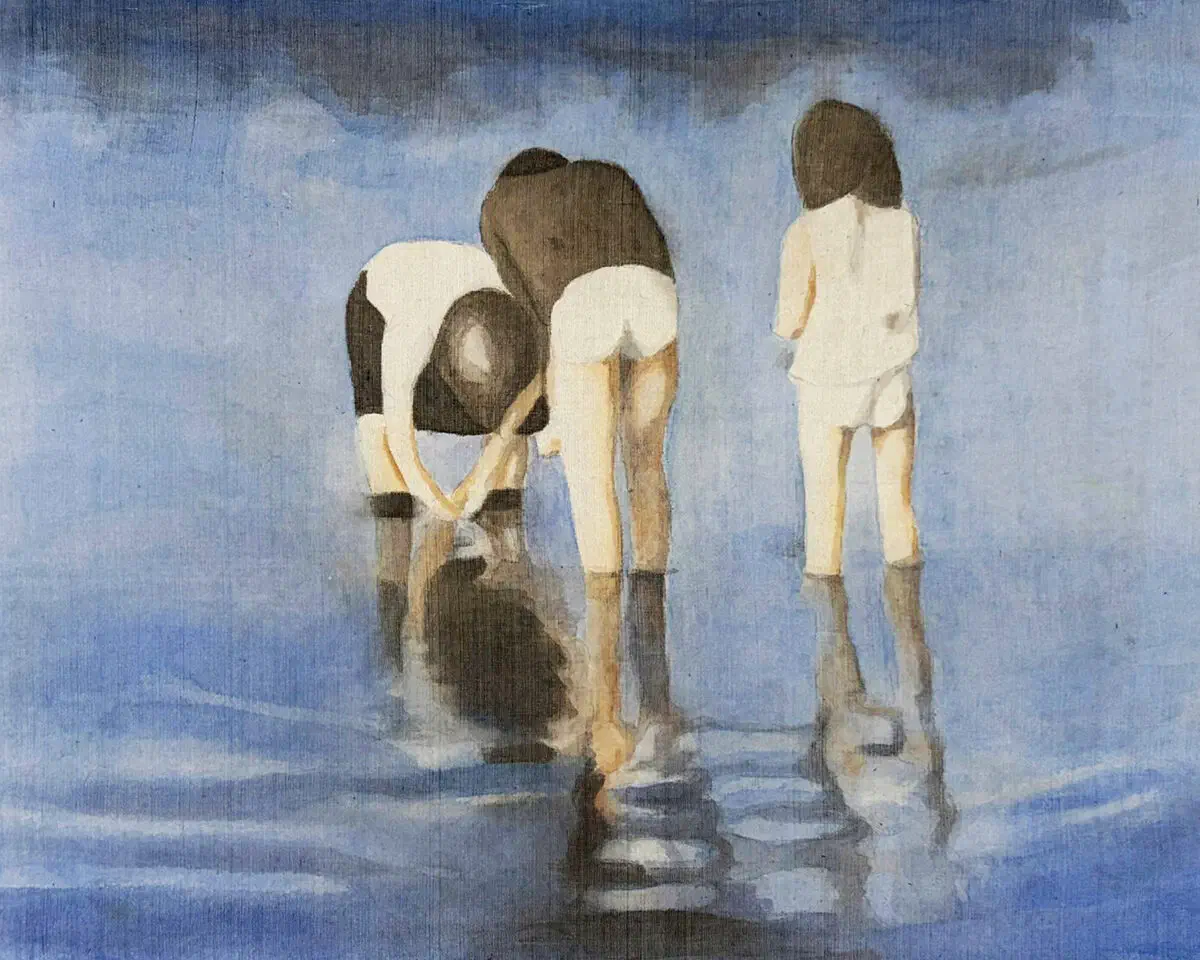
The data, consisting of situated field-based recordings documented through photographic media and information gathered through interactions with individuals present in the analysed contexts, are used to identify recurring and comparable patterns across the different investigated scenarios. For the presentation and interpretation of results, visualization methods based on techniques not attributable to contemporary Western representational systems are adopted, in order to highlight alternative perceptual configurations and different modes of articulating the visible. The representational strategies employed are based on obsolete and/or situated practices, including the use of adhesive screentones – tools employed in pre-digital geometric representation that are now increasingly difficult to access – and silk painting according to the traditional Vietnamese technique. Future developments of the research will include the use of ceramics as an additional medium of investigation within the Turkish context, as well as the realization of a workshop in the carceral setting, aimed at graphic production by inmates. The latter constitutes a privileged field of observation for analysing emerging visual practices under conditions of reduced availability of visual and material stimuli.
Bibliography
Bibliography
Campagna, F. (2023). Cultura profetica: Messaggi per i mondi a venire. Edizioni Tlon.
Cometa, M. (2023). Paleoestetica. Alle origini della cultura visuale. Raffaello Cortina Editore.
Consigliere, S. (2024). Fables of re-enchantment: Multiplicity, imaginary, revolution. Minor Compositions.
Gallese, V. (2026). Il Sé digitale: Dai neuroni specchio alla mediazione tecnologica. Raffaello Cortina Editore.
Pinotti, A. (2021). Alla soglia dell’immagine. Da Narciso alla realtà virtuale. Einaudi.