Giulia Bella
Supervisor
Giorgia Di Carlo
Giulia Bella
Supervisor
Giorgia Di Carlo
Graphic Design as a Political Act: Graphic Design's Role in the Communication of Political Resistance and the Destruction of Counter-Narratives
Quale ruolo per il design grafico nella comunicazione della resistenza e nella distruzione di contro narrative?
Research question
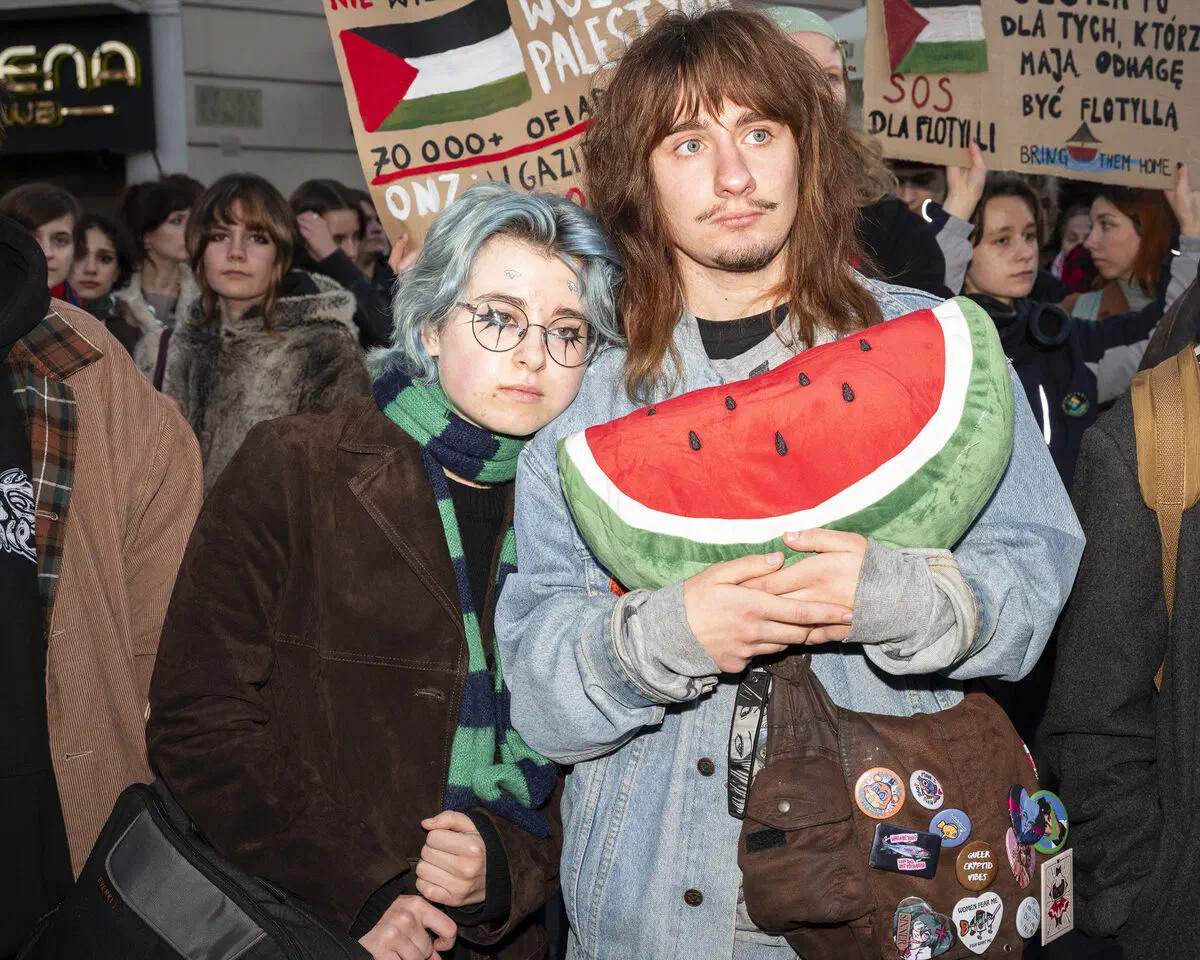
How can graphic design become a tool of resistance? This research investigates the visual grammars of dissent activated by resisting communities in situations of social urgency, by analysing how they vary according to cultural and geopolitical contexts. The project addresses a current research gap: although the history of graphic design has documented cases of resistance, it lacks systematic studies analysing protests as they unfold. The research aims to understand how visual languages of dissent are built and perceived in the collective imaginary and to identify the designer’s ethical and professional position in this process, including the risk of aesteticisation of protests. It will be crucial to investigate the dematerialisation of visual artefacts into digital resources and their ability to keep their semantic value. These questions position the research between graphic design and sociology, while establishing graphic design as a political act.
Methodology
The methodology will be mixed: at a qualitative level, through semiotic analysis of graphic artefacts from resisting communities in different geopolitical contexts, and interviews with designers engaged in activism. Quantitative data will be obtained by mapping the spread and perception of dissent images on social media, following criteria observed in studies on online activism campaigns (Fagerholm et al., 2023). The research on perceptions of visual political communication on social media will be defined through a systematic study that will lead to an appropriate methodology.
Case Studies
The analysis of case studies on urgent issues affecting different resisting communities has shown that the visual lexicon varies depending on geopolitical context, even if the main topic is the same. Nevertheless, recurring themes and languages, both verbal and visual, emerge across different resistance cases. The research integrates contributions from studies on visual and digital communication (Yudhanto et al., 2023), participatory design and graphic activism (Guayacan and Tjahja, 2022), and visual political communication on social media (Awad et al., 2022). Nagi and Nathalea (2025) and Guayacan and Tjahja (2022) address the dematerialisation of graphic artefacts in conditions of urgency; this highlights the need to further investigate the relationship between designers, resisting communities, and collective practices.
Data Analysis and Interpretation of Results
Case study data confirm that the shift to digital space generates connections between communities (Fagerholm et al., 2023); however, Guayacan and Tjahja’s study, though exploring the designer’s role between activism and profession, is limited to a single case. These results pave the way for this research to formalise a critical theory of visual lexicons of resistance, which will fill the identified research gap and offer interpretive tools for design studios and cultural institutions that document contemporary protests.
Image caption
Bibliography
Bibliography
Awad, S., Doerr, N., & Nissen, A. (2022). A far-right boundary construction towards the “other”: Visual communication of Danish People’s Party on social media. The British Journal of Sociology, 73(5), 985–1005. https://doi.org/10.1111/1468-4446.12975
Fagerholm, A.-S., Göransson, K., Thompson, L., & Hedvall, P. O. (2023). Activism online: Exploring how crises are communicated visually in activism campaigns. Journal of Contingencies and Crisis Management, 31(4), 1034–1043. https://doi.org/10.1111/1468-5973.12472
Guayacan, M. A., & Tjahja, C. (2022). Self-designing protests: Exploring participatory design activism through the Colombian graphic (design) explosion. In PDC 2022: Proceedings of the 17th Participatory Design Conference (Vol. 2, pp. 103–110). ACM. https://doi.org/10.1145/3537797.3537818
Nagi, E., & Nathalea, M. M. (2025). Trends and research directions in graphic design for social values and cultural identity: A systematic literature review. International Journal of Graphic Design, 3(2), 340–364. https://doi.org/10.51903/ijgd.v3i2.3101
Yudhanto, S. H., Risdianto, F., & Artanto, A. T. (2023). Cultural and communication approaches in the design of visual communication design works. Journal of Linguistics, Culture and Communication, 1(1), 79–90. https://doi.org/10.61320/jolcc.v1i1.79-90