Federica Bistoletti
Supervisor
Giorgia Di Carlo
Federica Bistoletti
Supervisor
Giorgia Di Carlo
Rights, Duties, and Responsibilities of the Graphic Designer: Graphic Design Advocacy and Networking
Graphic design advocacy e networking
Research Question:
How can a community be built and represented through graphic design? Keywords: co-design, community, restanza, participatory research, social design
Methodology for Achieving the Objectives:
The research analyzes communities of graphic designers who practice their profession in locations outside a country’s economic center. The term “restanza” (Teti, 2022) is used here to refer to the restoration of graphic designers’ right to inhabit their place of origin and to contribute to the creation and dissemination of positive value. The approach adopted is research by making (Rasch, Gijsen, & Staal, 2024), which intertwines with social design practices in order to construct a framework grounded in agency, community, and territory. Through a combination of benchmarking and case studies selected for their participatory nature and the generation of shared design, we observe how graphic design becomes relational infrastructure and a tool for community building; a need within which workshops serve as devices for dialogue that translate shared space and identity into graphic design.
Case Studies:
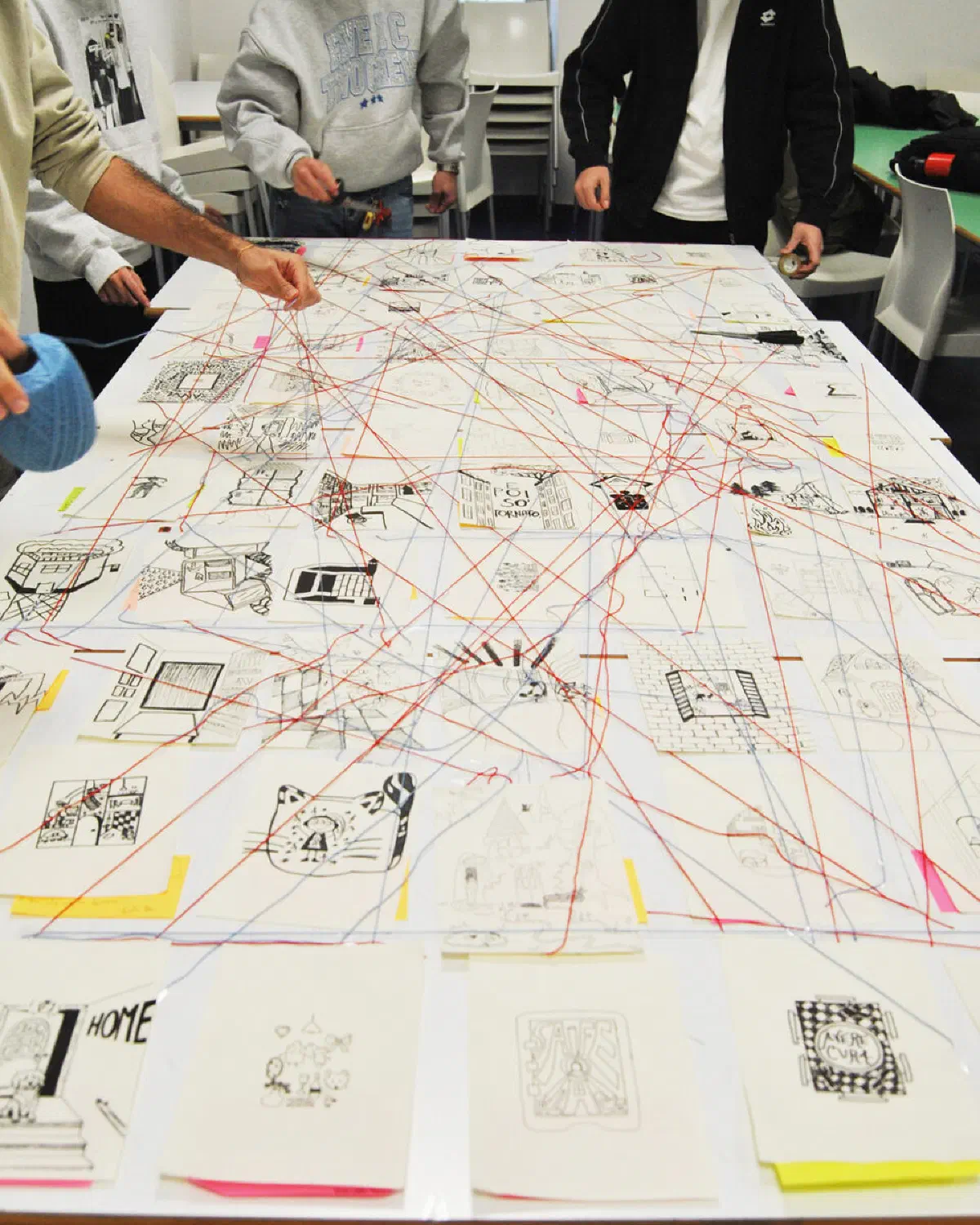
DA ME O DA TE: A workshop with students from the Graphic Design 3 class (Academy of Fine Arts in Catania), which invited participants to represent themselves as a physical or symbolic home, exploring their personal position within the group. The artifacts formed a virtual neighborhood connected by colored threads; this shifted the focus from the individual to the whole, and to the interactions between “invitations” and “visits.”
Segni di appartenenza. Manifesto co-progettato: A workshop linked to the project “Get Up–DesTEENazione,” which encouraged students at the IIS Carlo Gemmellaro in Catania to reflect on the neighborhood as a shared space. Through graphic synthesis, places were transformed into symbols, which were collected in a poster and individual cards that narrated the process of constructing meaning.
microgatherings: A workshop with students from the Social Design Studio (die Angewandte, Vienna), which posed the question: “What brings people together the most?” Twenty students observed and commented on eight community axes, then used confetti of different shapes and colors as a visual representation of the data. This created an artifact that shows how designers experience different ways of being together, and in which it is possible to observe the patterns of the collected data according to the variables of dynamism, quantity, and dominant color.
Data Analysis and Interpretation of Results:
The workshops took place in three different educational and geographical contexts, to record useful data regarding the transferability of co-design practices within projects aimed at community building. Individual students were asked to to situate themselves within the group and reflect on their role within the community (real, constructed, or imagined), which generates value and resilience. Through a cycle of observation, dialogue, solution-seeking, design, and shared reflection, a “paradoxical landmark” was conceptualized: this is a marker with the unique (and indeed contradictory) characteristic of being in constant motion, as it listens to the community’s changing needs and translates them through graphic design.
Bibliography
Bibliography
Campagnaro, C., Ceraolo, S. (2022). Ai margini. Un’antologia di social design. Prinp Editore.
Offermanns, I. (2022). Graphic Design Is (…) Not Innocent. Valiz.
Rasch, M., Gijsen J., Staal H. (2024). Hands on research for artists, designers & educators. Set Margins’.
Teti, V. (2022). La restanza. Einaudi.