Elisa Raciti
Supervisor
Marco Lo Curzio
Elisa Raciti
Supervisor
Marco Lo Curzio
Sicilian Chronicles: Speculative Design Practices to Promote Collective Imagination and Futures Literacy in Complex and Damaged Territories
Pratiche di design per l’immaginazione collettiva e future literacy in territori complessi e danneggiati
Research question
How does the role of the designer change as a mediator between community and decision-making processes? How does speculative design translate the complexity of a territory into imaginaries that help to mediate between citizens and policymakers?
Methodology
The proposed research is qualitative practice-based and integrates speculative design, social innovation and participatory design.
Research through design generates knowledge through the practical act of the project: participatory practices embed the research in the local context and allow the designer to observe actively. The process is intended to encourage the co-design of experiential futures; make complex scenarios tangible; and develop a collective futures literacy that facilitates the mediation among different actors. The process aims to transform collective imagination into a driver of social innovation by enabling communities to actively co-design change in their own territory.
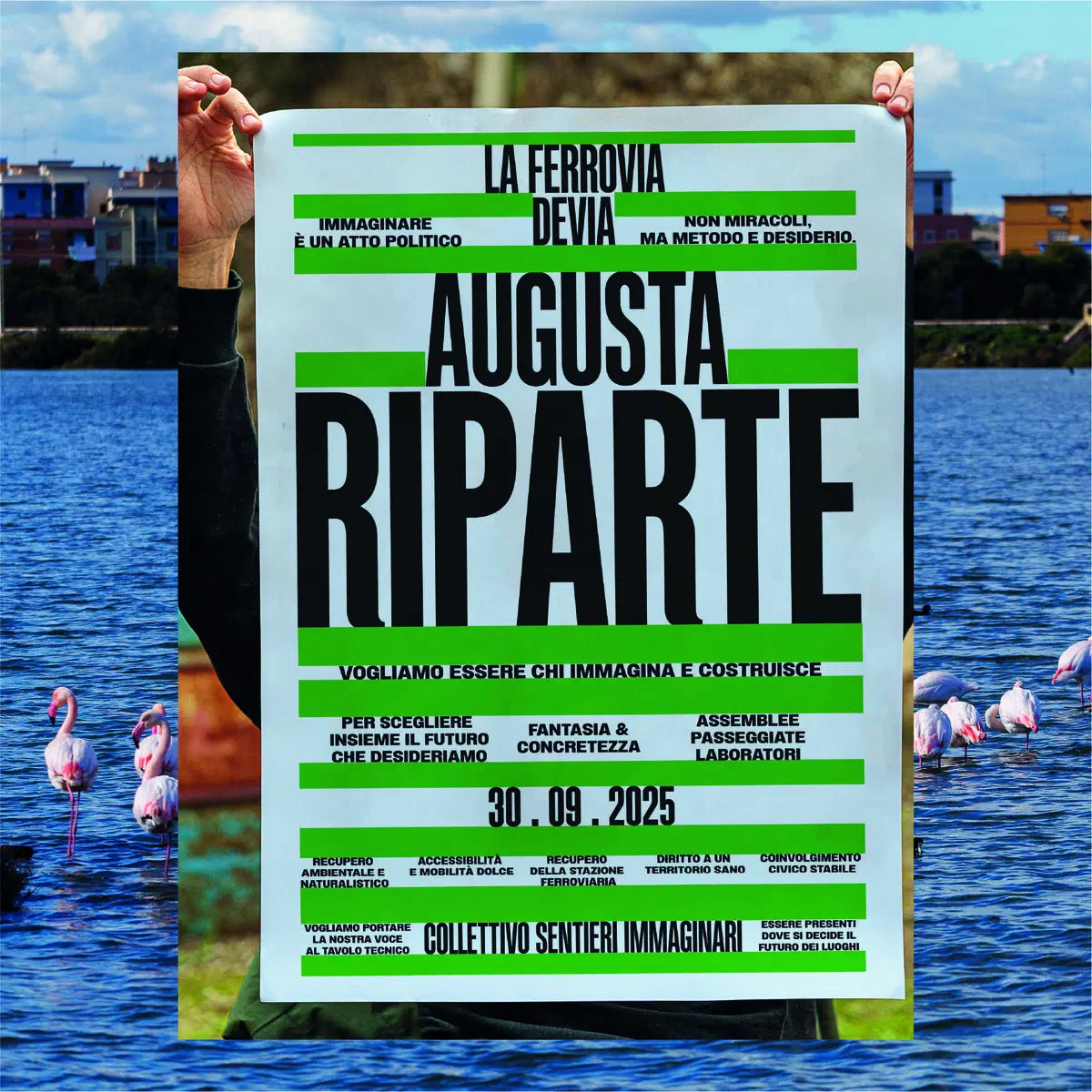
Case Studies Sentieri Immaginari is a collective of activist citizens from Augusta, a city on the Sicilian coast marked by petrochemical industrialization, and an area defined as an environmental sacrifice zone (Pinto, 2025). The designer facilitates and participates in assemblies and layered mapping sessions (historical, infrastructural, ecological), which she visualizes and translates into graphic artefacts that are discussed and reworked. The project structures participatory speculative imagination sessions; these act as a methodological device to foster dialogue with decision makers and promote the co-creation of new political trajectories. Design for Climate Imaginaries is a research and training programme on climate change and social equity, intended as a learning tool where scientific knowledge and collective practices intertwine. The project experiments with educational tools that visualize the interrelationships between space, ecology, and society; local communities are placed at the centre of processes of change, by using the Piazza Garibaldi area in Naples as a living laboratory. Analysis and Interpretation Environmental damage is a ‘hyperobject’; it cannot be directly experienced because it is distributed across time and space. Can speculative design translate such ideas into imaginaries for navigating this complexity? Participatory design generates a ‘contestable space’ (Manzini 2025) where communities and policymakers can share a common imaginary. The new must emerge from the interaction of different actors who act partially without knowing which figure they are contributing to create (Lorusso, 2025). The imagination of a eutopian future is intended to highlight the tensions (Cardini and Wang, 2024) of a damaged territory: contamination, residual biodiversity, and unrealized possibilities. It is expected that grounding the work in a specific place and community, through situated and participatory practice, will mitigate the risk of speculative design remaining an abstract and self-referential exercise. Translation, mediation, and the eutopian imagination generated through co-designed visualizations can develop a shared futures literacy (Sikorska, 2024) between citizens and policymakers.
Bibliography
Bibliography
Cardini, P., & Wang, I. V. (2024). ReFuturing: New prompts for new ecological visions. In R. B. Egenhoefer (Ed.), Routledge handbook of sustainable design (2nd ed). Routledgeedge handbook of sustainable design (2nd ed). Routledge.
Lorusso, S. (2025, March 21). Late futurism: The future as a mode of the present [Issue 3.2]. Hotpot. Parco Gallery. https://gallery.frakas.design/late-futurism-the-future-as-a-mode-of-the-present-2/
Manzini, E. (2025). Sailing against the wind. In I. Mitrovi? & D. Vanette (Eds.), Reclaiming hope: navigate (un)certainty, imagine better futures. The Centre for Creativity, Museum of Architecture and Design.
Pinto, A. (2025). Il sacrificio ambientale come disuguaglianza territoriale. In F. Perocco & G. Pirina (Eds.), Le disuguaglianze territoriali in Italia (pp. 399–418). Edizioni Ca’ Foscarinze territoriali in Italia (pp. 399–418). Edizioni Ca’ Foscari.
Sikorska, J. (2024). Collective climate imagination: Towards a collective imagination and design practice for transformative climate adaptation. University of Applied Arts Vienna.