Cristina Iurissevich
Supervisor
Lorenzo Di Silvestro
Cristina Iurissevich
Supervisor
Lorenzo Di Silvestro
Visual Atlas: The Representation of the Feminine in the Media and Contemporary Art
La rappresentazione del femminile tra media e arte contemporanea
Research Question
This research aims to investigate the condition of women through the study of their representation in contemporary art and media. As a practice-led research project, it seeks to create a Visual Atlas dedicated to images representing women. It aims to understand how the representation of the body has changed and how cultural norms have influenced this representation.
Keywords: Gender imagery, Italy, Spain, authoritarianism, feminism
Methodology to Achieve Objectives
A questionnaire was developed to collect quantitative and qualitative data and administered to individuals who have lived in Spain and Italy. Data collection began in Spain, and to date, 51 responses have been received; the sample is not yet representative, so the questionnaire remains active. In addition to some general questions about the respondents, they were asked whether they are involved in activities related to art, activism, research, study, or creative professions, and whether they believe the representation of women in their country today is neutral. They were also asked to select keywords related to the media representation of women (the keywords were generated based on a real-world classification of the frequency of adjectives associated with the terms ‘woman’ and ‘girl’ drawn from two Italian and two Spanish linguistic corpora). In the second part of the questionnaire, participants were asked to provide an image representative of the female gender in contemporary Spain, a title for the image, its source, a description, and five keywords that could describe it. Following the questionnaire, interviews will be conducted with artists, art historians, and researchers, and focus groups will be held to discuss the images received.
Case Study
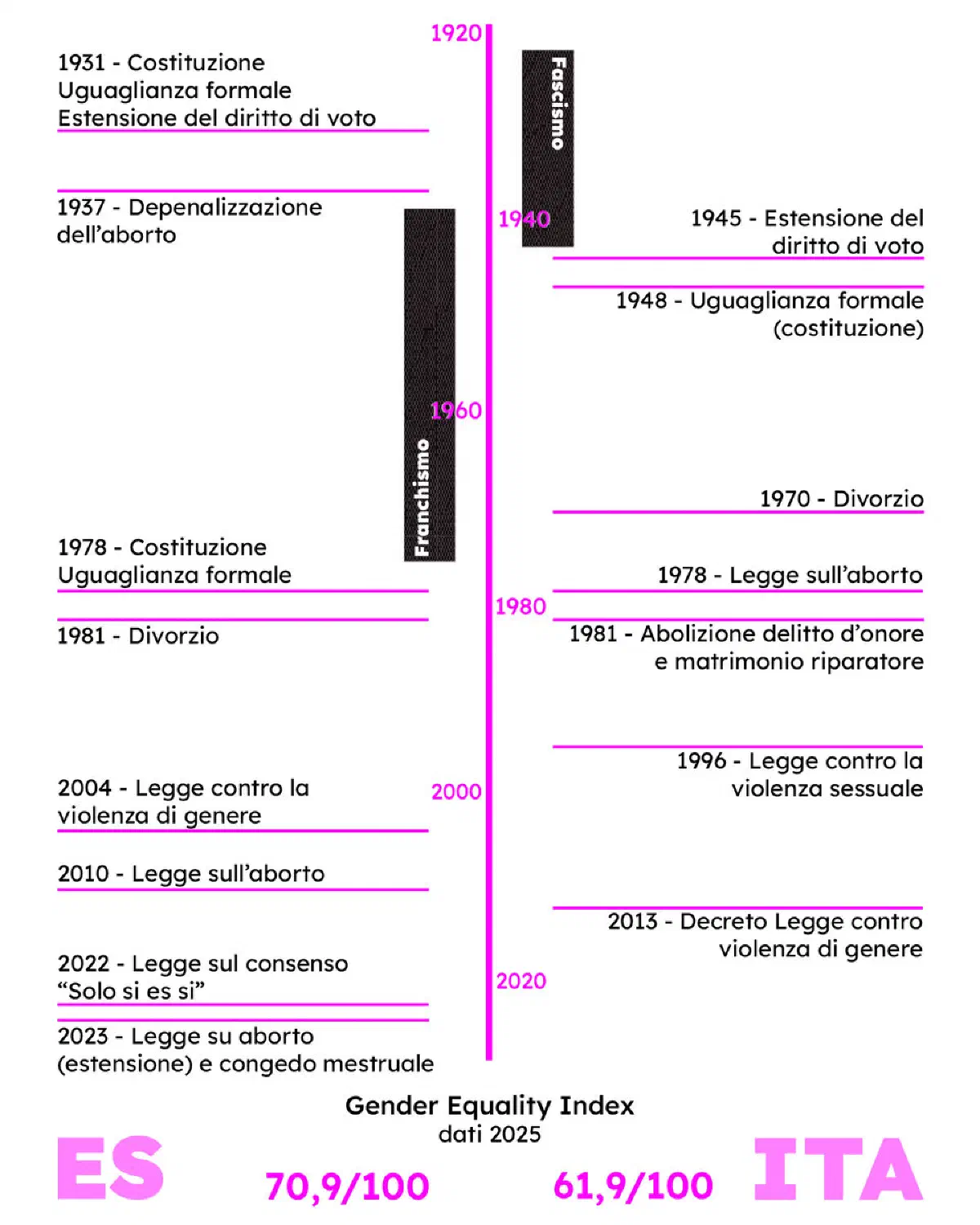
The comparison between Italy and Spain was undertaken because they share a similar cultural model (geographical area, initial economic status within the European Community, and overcoming a fascist dictatorship). Yet gender disparities are stark, as demonstrated by the European Institute for Gender Equality’s indices. The representation of research through image collection is an innovative and useful metric for understanding the vision and imagery of a gender within society. This will be supplemented by questionnaires, interviews, and focus groups in both countries involved.
Data Analysis and Interpretation of Results
In Spain, responses were received from 32 women, 16 men, 2 non-binary individuals, and 1 person who preferred not to answer. Overall, 86% of respondents believe that the image of women is not neutral. In response to the question “When you think about the media representation of women in Spain today, which of these keywords would you choose?”, the three most frequently selected keywords were: young (18.34%), beautiful (17.75%), and working (12.43%). The images received were highly diverse.
Bibliography
Bibliography
de Miguel Álvarez, A., & Miyares , A. (2025). 50 años de feminismo en España y América Latina. Cuestiones de Género: de la igualdad y la diferencia, (20), 1–6. https://doi.org/10.18002/cg.i20.9301
Gill, R. (2022). Being watched and feeling judged on social media. Feminist Media Studies, 21, 1–6. https://doi.org/10.1080/14680777.2021.1996427
Jiang, Y. (2024). From Instagram to Society: The Impact of Social Media on Female Self-Sexualization. Communications in Humanities Research, 35. https://doi.org/10.54254/2753-7064/35/20240037
López Fernández, V. (2021). Orígenes del arte feminista español: de 1960 a 1970. Feminismo/s, (37), 307–331. https://doi.org/10.14198/fem.2021.37.13
Padilla Castillo, G., Brandariz Portela, T., Ortega Fernández, E., & Pino Díaz, D. D. (2026). La construcción de ‘feminidades’ digitales: Análisis de las cuentas Ballerina Farm y Roro en la manosfera de TikTok. Clepsydra. Revista de Estudios de Género y Teoría Feminista, (30), 83–106. https://doi.org/10.25145/j.clepsydra.2026.30.03