Chiara Nicoletta Compagnino
Supervisors
Viviana Scalia
Loredana Faraci
Chiara Nicoletta Compagnino
Supervisors
Viviana Scalia
Loredana Faraci
Memory and Materiality of the Stage: The Teatro Stabile di Catania Archive as a Common Good
L’archivio del Teatro Stabile di Catania come bene comune
Research question
How can the historical archive of the Teatro Stabile di Catania (TSC) be organised, catalogued and digitised as a common good (Settis, 2012), combining conservation, accessibility and the transmission of memory through innovative models inspired by the most significant institutional theatre practices?
Methodology
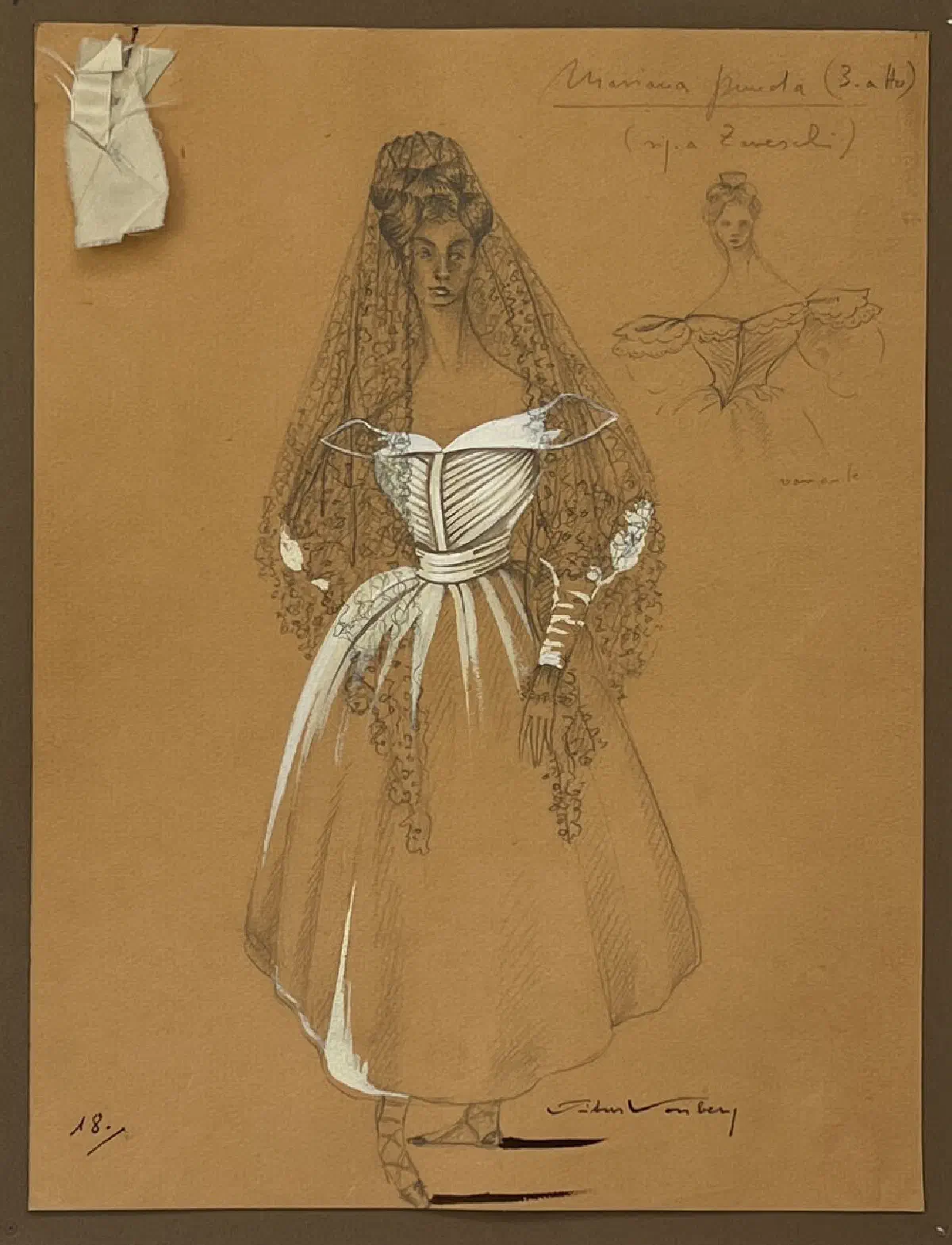
The research adopts a practice-led approach and is divided into two complementary phases. The first, empirical phase involved direct work on the TSC collection: physical recovery, reorganisation and scientific cataloguing in accordance with national ICCD standards, using D forms (sketches and costume designs) and S forms (playbills and posters), with a focus on the decade 1958–1968. The research’s qualitative approach led to the cataloguing of approximately 751 archival units. The second, comparative phase compared Spanish cataloguing and digitisation models with the Italian system, aiming to develop a replicable methodological protocol for the TSC archive.
Case studies
The study draws on specific case studies to examine different models of archival management. The work conducted on the TSC collection provides a useful point of comparison with the practices adopted by the Reina Sofía Museum, chosen because it addresses the tension between archival and museum logic in the management of documentary materials of artistic value—a critical issue shared with the TSC collection. With thousands of documents across the Central Archive and Documentary Collections, the museum adopts a hybrid system (MARC 21+ISAD(G)) with tiered access on its web platform. The interview with Laura P. González offered an opportunity to explore the “porosity of the artistic fact”: sketches and costume designs as materials that straddle the boundary between document and artwork. Added to this are observations regarding the Traje Museum, which adapts the DOMUS system to ephemera, and the CDAEM and CIRAE, which address interoperability and data aggregation on international platforms such as Europeana.
Data analysis and interpretation of results
In the absence of an up-to-date census of Italy’s theatrical heritage, the research involved a questionnaire sent to various institutions, supplemented by interviews conducted with Spanish organisations involved in the comparative phase. The analysis provided an in-depth understanding of working methods and actual interoperability levels, enabling a comparison of organisational models. A common critical issue emerges: the difficult coexistence of archival and museum logic, which sometimes leads to the use of museographic tools in archives, compromising the organic relationships within the collection and violating the principles of international archival science. The solution is not mass digitisation, but the setting of priorities: for the TSC, the early years of activity are the most vulnerable and require urgent action. These models guide the TSC towards a three-tier protocol: ISAD(G) for the description of the collection, ICCD for the enhancement of individual materials, and tiered accessibility to balance public access and the protection of the heritage.
Bibliography
Bibliography
Allegrezza, S. (2021). La digitalizzazione del patrimonio culturale. Linee guida, standard, esperienze. Torre del Lago Puccini.
Borgi, M., Novello, E., & Simonetti, R. (A cura di). (2021). Archivi 4.0 e Paesaggio. La digitalizzazione del patrimonio culturale. Cleup.
Bruni, F. (2023). EuropeanaReuse: la Commissione europea e il riuso del patrimonio culturale digitale. DigItalia. Rivista del digitale nei beni culturali, 3(2).
Esteban Celorio, L. (2024). Web y archivo digital, el objeto semántico como modelo de interfaz y herramienta en la museología contemporánea [Tesi di dottorato/Master, Universidad Autónoma de Madrid]. Repositorio Institucional UAM.
Pedrazzi, R. (2023). L’intelligenza artificiale per il riuso dei patrimoni digitali: stato dell’arte e prospettive future. DigItalia. Rivista del digitale nei beni culturali, 3(2).