Alberto Rota
Supervisor
Chiara Pirozzi
Alberto Rota
Supervisor
Chiara Pirozzi
Orchestrating Places: The Artist-Designer
Artista-designer: l’incidenza delle arti applicate nella produzione artistica contemporanea
Research question
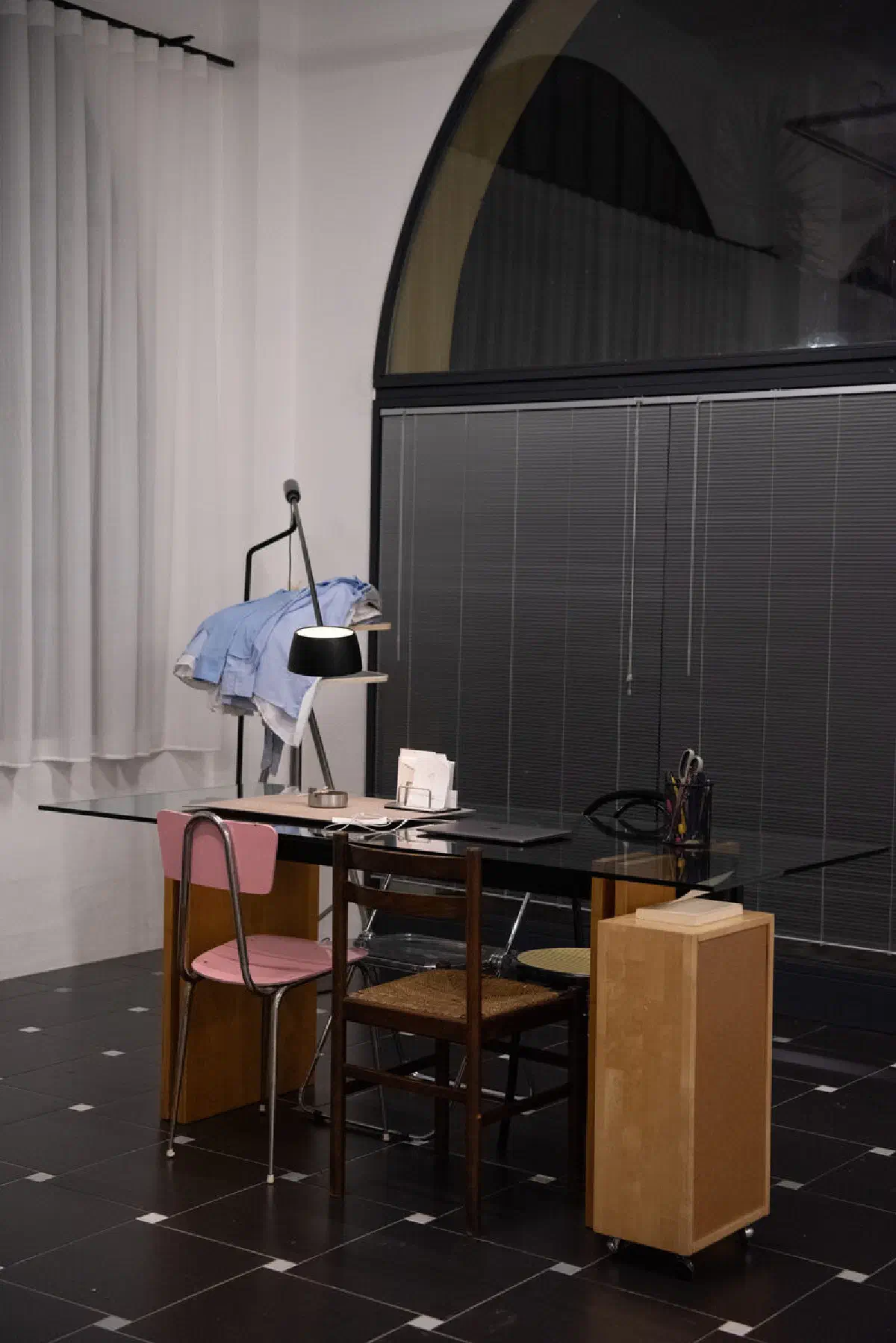
This research exposes the exhibition display as a methodology capable of generating meaning. By ‘display’, we mean the set of spatial and installation devices that contribute to the ‘staging’ of the artwork: from the plinth to a slightly off-centre nail. The study addresses two main questions: How does the artistic object ‘inhabit’ the space? And how does the display influence its appearance and reception? The domestic exhibition setting is taken as the primary field of investigation, in which the artwork is presented in continuity with everyday objects, and thereby emerges ass a ‘thing among things’.
Methodology
The methodology adopted is hybrid and multidisciplinary, combining theoretical research, practice-based research and research-through-the-arts approaches. The theoretical component is grounded in exhibition studies, and art-historical and critical perspective within the fields of art and architecture. The practice-based component, developed through personal artistic practice in the form of sculpture and installation, constitute the main field of observation and functions as a tool for critical testing and reconfiguration. The operational element is the independent space centro M*SSAGGI, a home-studio and home-gallery, which serves as a lived experimental platform where domestic and exhibition dimensions coexist and define one other. The research through-the-arts approach is articulated through dialogue and collaboration with artists and researchers, facilitated via workshop and interviews.
Case studies
The research is structured around a series of a case studies, as a method that combines the analysis of external practices with direct experimentation. centro MSSAGGI serves as the primary operative device: it enables the insertion of the artwork into a pre-existing, inhabited space, and the observation of its perceptual and relational implications: two people were seated at a table, between them an ashtray bearing the inscription ‘STRAPENSIERO’; the murmur, the buzz. This is complemented by analysis of contemporary practices, which are studied for their ability to interrogate the display across different fields such as design, fashion and architecture, and engaged through forms of direct comparison. ANALYSIS AND RESULTS The analysis is developed through the interplay of empirical observation, installation practice and theoretical analysis. An initial phase involved a phenomenological examination of the display in historical artistic practices, alongside direct observation of contemporary contexts; this revealed a growing prominence of exhibitionary and display-oriented logics. The experiments conducted within the centro MSSAGGI, and in particular POSTURE open-studio, have highlighted how relocation of works within a domestic space produces a perceptual and interpretive shift. The work loses its semantic stability and is redefined according to conditions of ambiguity between aesthetics object and functional object. In light if these observations, the display can be interpreted as a heteronomous extension of architecture, which is capable of amplifying its operative capacities and activating a ‘participatory’ dimension of aesthetic perception. DIDASCALIA Bergamo, centro M*SSAGGI.
Bibliography
Bibliography
Coccia, E. (2021). Filosofia della casa: lo spazio domestico e la felicità. Einaudi.
Di Rosa, V. (2023). La mostra come medium: storia e teoria. Mimesis.
Huber, A. (2024). Conforme/Difforme, Io mostro, misure di realtà nella pratica espositiva. Mimesis Edizioni.
Modena, E. (2024). Display: luoghi dispositivi gesti. Giulio Einaudi.